How to Style Graphic Hoodies: Outfit Formulas That Work
Learn how to style graphic hoodies with outfit formulas, layering rules and fit checks for everyday, warm-weather and active days.

In this article
- Why the Graphic Should Lead the Outfit
- Measure the Hoodie Before You Style It
- Three checks in the mirror
- Outfit Formulas for Every Graphic Hoodie
- The rule behind the table
- How to Build the Outfit Around the Print
- The healthy-outfit check
- Layering Without Hiding the Graphic
- Styling for Comfort, Heat and Movement
- Adjust by context, not by body type
- Plan Your Next Hoodie Outfit This Week
About 45% of hoodie sales happen online, according to a 2025 hoodie market compilation by Colorful Socks. That means a large share of the hoodies people are wearing this week were bought from a product page, sight unseen, with the fit decided by a size chart and a bit of hope. Styling starts there, not at the sneakers.
Most advice about how to style graphic hoodies stops at colour matching. Cap to the print, white sneakers, done. That approach collapses the moment the hoodie arrives slightly short in the body, or the sleeves twist under a jacket, or the wearer needs to sit through a two-hour commute with headphones on.
A better method runs in three passes. Decide which pieces support the print, verify the fit with a tape measure before building around it, then adjust for the day you're having: hot office, cold street, long train, active afternoon.
Why the Graphic Should Lead the Outfit
A 2025 consumer study across 15 countries, reported by Dataintelo's global hoodies market report, found that 68% of respondents aged 18-45 wore hoodies at least three times per week. Read that as a wardrobe fact rather than a shopping signal. The hoodie is already in rotation several days a week, so what many wearers lack isn't another one, it's a dependable way to build an outfit around the one they own.
The print decides the hierarchy. Motivational lettering, athletic imagery, hiking type, Y2K graphics, seasonal art: each one functions as a single visual block the eye lands on first. Everything else either supports that block or steps out of its way. A graphic hoodie over a busy bottom with a patterned cap isn't layering, it's three things arguing in public.
The test: if the graphic isn't the first thing someone notices, the rest of the outfit is working against it.
Three decisions carry the whole look: which pieces pair with the print, how fit and layering change what the print reads like from a distance, and how comfort and wear frequency shift the choice. A hoodie that looks sharp on a model can still fail on a real body in a real week. So the outfits below get checked against fit and occasion, not against a photograph. By the end you'll have a formula you can run on the next morning you get dressed.
Measure the Hoodie Before You Style It
Fit errors sink outfits that were otherwise well chosen. Online clothing return rates can reach 25-40%, and poor fit was the main driver in a study of 1,024 respondents, accounting for 62% of returns, per Rendered Fits' compilation of fashion return statistics. Those numbers describe shopping, but they describe styling too. A hoodie that doesn't fit can't be rescued by better trousers.
Start with a hoodie you already wear and like. Lay it flat, smooth the wrinkles out, and measure it. Then compare those numbers against the size chart of the product you're considering. Don't assume sizing up produces a fashionable oversized fit. In practice, sizing up adds body length and shoulder width before it adds the drape you were picturing.
| Measurement | How to Measure | What It Tells You |
|---|---|---|
| Pit-to-pit width | Lay flat and measure armpit to armpit, then double | How much room the body has and whether layers will fit |
| Shoulder width | Measure seam to seam across the back | Whether the graphic looks sized correctly across the chest |
| Sleeve length | Shoulder seam to cuff | Whether cuffs cover the wrists when the arms are raised |
| Body length | High point of shoulder to hem | The proportion between the hoodie and the footwear |
| Hem width | Measure the flat hem edge, doubled | How the hem sits over the trousers' rise |
Classify the result you want before you buy or build: regular, relaxed, oversized, or cropped. Each one changes which bottoms and shoes can carry it.
Three checks in the mirror
- Shoulder seam: it should sit at or just past the shoulder bone. Fabric spilling halfway down the arm makes the print across the chest look smaller than it is.
- Hood at the neck: it should rest behind the neck without pulling forward. A hood that drags means the back panel is short or the neckline is cut wide.
- Hem and rise: the hem should land at the top of the trousers' rise. Drop it much lower and the legs start to look short, which distorts the hoodie-to-footwear proportion.
Anyone choosing between several prints and cuts should read this guide to choosing graphic sweatshirts for everyday wear before the tape measure comes out.
Outfit Formulas for Every Graphic Hoodie
Pick the occasion first, then the formula, then step back and check the print is still readable from a metre away. That order matters. Choosing the hoodie first and hunting for a plan second is how a wardrobe fills up with pieces that only work one way.
| Occasion | Bottoms | Footwear | Layer or Accessory |
|---|---|---|---|
| Weekend errands | Black or washed denim | Clean low-profile sneakers | Cap in the print colour |
| Warm weather | Denim or cargo shorts in ecru or olive | Canvas slip-ons or low sneakers | Hoodie worn open with sleeves pushed up |
| Transitional weather | Straight-leg charcoal trousers | Chelsea boots or leather sneakers | Lightweight overshirt over the hoodie |
| Smart-casual night out | Dark tailored trousers | Clean white leather sneakers | Single neutral accessory, no second print |
| Active or outdoor day | Tapered olive joggers | Trail or running sneakers | Light shell jacket |
| Travel or long commute | Relaxed chinos or soft joggers | Comfortable slip-ons or sneakers | Open jacket instead of a second bulky layer |
The rule behind the table
One bold graphic per outfit. Any additional pattern or high-saturation colour gets cut, not balanced. Neutrals do the supporting work so the print stays legible, and the footwear decides whether the whole thing reads as deliberate or accidental.
Notice how the formulas shift their emphasis rather than their pieces. Warm weather pushes the hoodie open and lightens the shoe. The smart-casual row swaps the texture of the bottom instead of adding a second statement. The travel row is the only one where comfort outranks shape, which is why a soft jogger or relaxed chino earns its place.
How to Build the Outfit Around the Print
Start with the print, not the wardrobe. The hoodie is the visual focal point, so every other piece either supports it or competes with it. Repeat the dominant print colour once in a small accessory or shoe, keep trousers and most outer layers neutral, and stop adding once the graphic reads clearly. That sequence is what separates an outfit with a print from an outfit about a print.
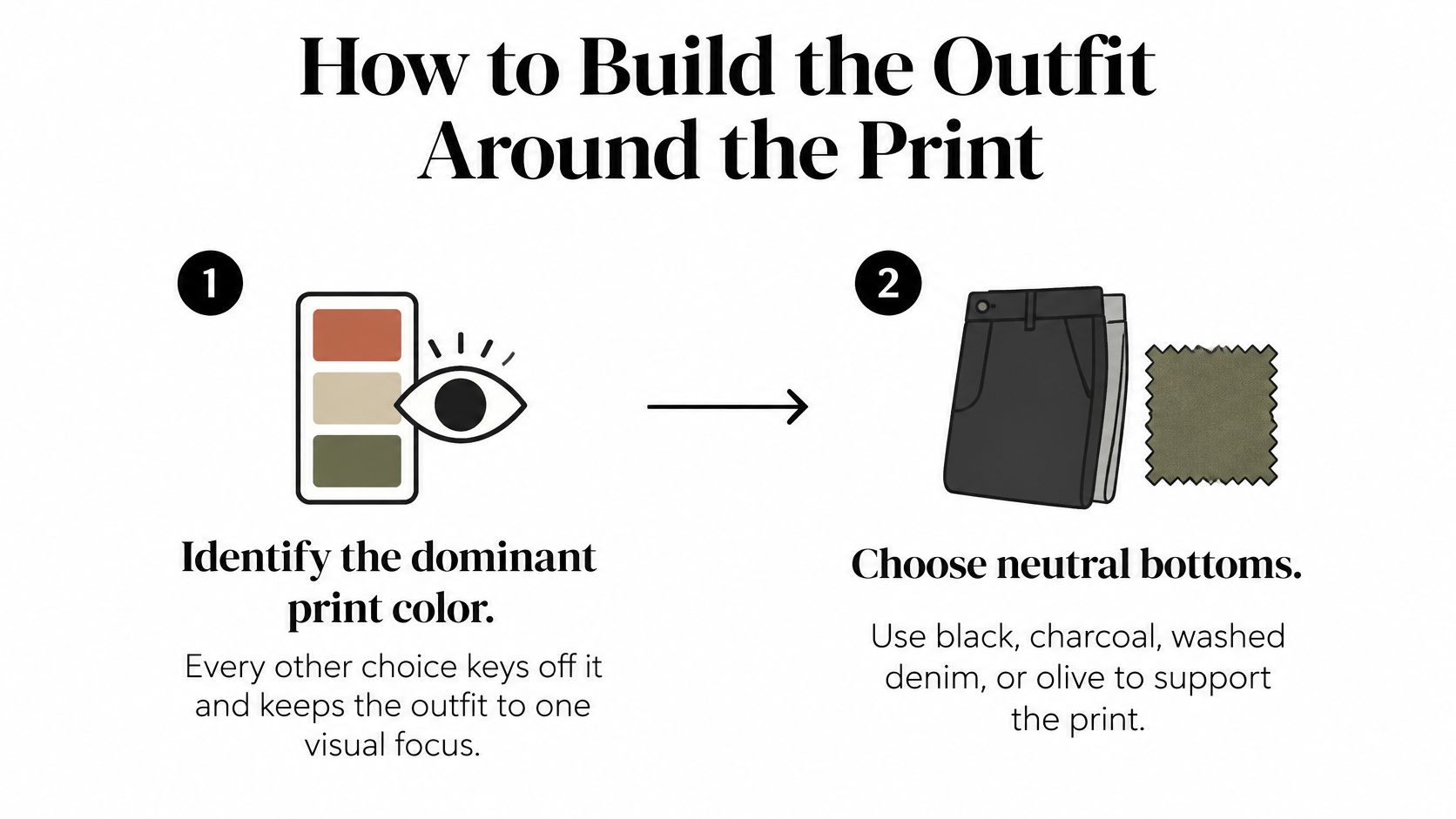
- Identify the dominant print colour. Everything else keys off it. A graphic that is mostly rust and cream has already decided your accent and your warm neutral. Skipping this step is how outfits end up with four unrelated colours fighting for attention.
- Choose neutral bottoms. Black, charcoal, washed denim, olive or ecru. The common slip is bright trousers chosen to "match the vibe", which compete with the graphic and make both look cheaper. Neutral bottoms give the print room to be the one loud thing.
- Add only one secondary element. A bold cap, a coloured sock, a single high-saturation piece. Stacking two patterns because each looked good alone leaves two focal points cancelling each other out.
- Repeat the print colour once, somewhere small. Laces, a belt, the ribbed cuff peek, a sock line. A single quiet echo ties the look together. Three repeats turns styling into a costume.
- Keep the base layer's neckline or hem discreet. A tee collar that peeks out works when it looks deliberate and fails when it cuts across the graphic. A longer hem under a cropped or boxy hoodie lengthens the leg line; a tee that ends at the same point as the hoodie widens the torso and adds bulk where nobody wants it.
- Check the full silhouette from the front and the back. Back prints, hem length and the way the hood sits all show problems the front view hides. Two minutes in a mirror saves a day of adjusting.
The healthy-outfit check
Three quick tests. The graphic should be readable at arm's length, not squinted at. The outfit should look intentional from the doorway, not accidental. And the footwear shouldn't dominate the frame, because if the shoes are the loudest element, the print has already lost.
One more check that matters on long days: if the collar rubs, the hood pulls the print off-centre, or the cuffs sit tight enough to distract you, the outfit fails regardless of how well the colours work. Comfort is part of the styling decision, not a separate one.
Layering Without Hiding the Graphic
One test settles most layering choices. Put the hoodie on, pull the jacket over it, raise both arms above your head, then close the jacket. If the neck bunches or the sleeves twist, the outer layer is too bulky or cut for a different body. No amount of pulling and adjusting fixes incompatible construction.
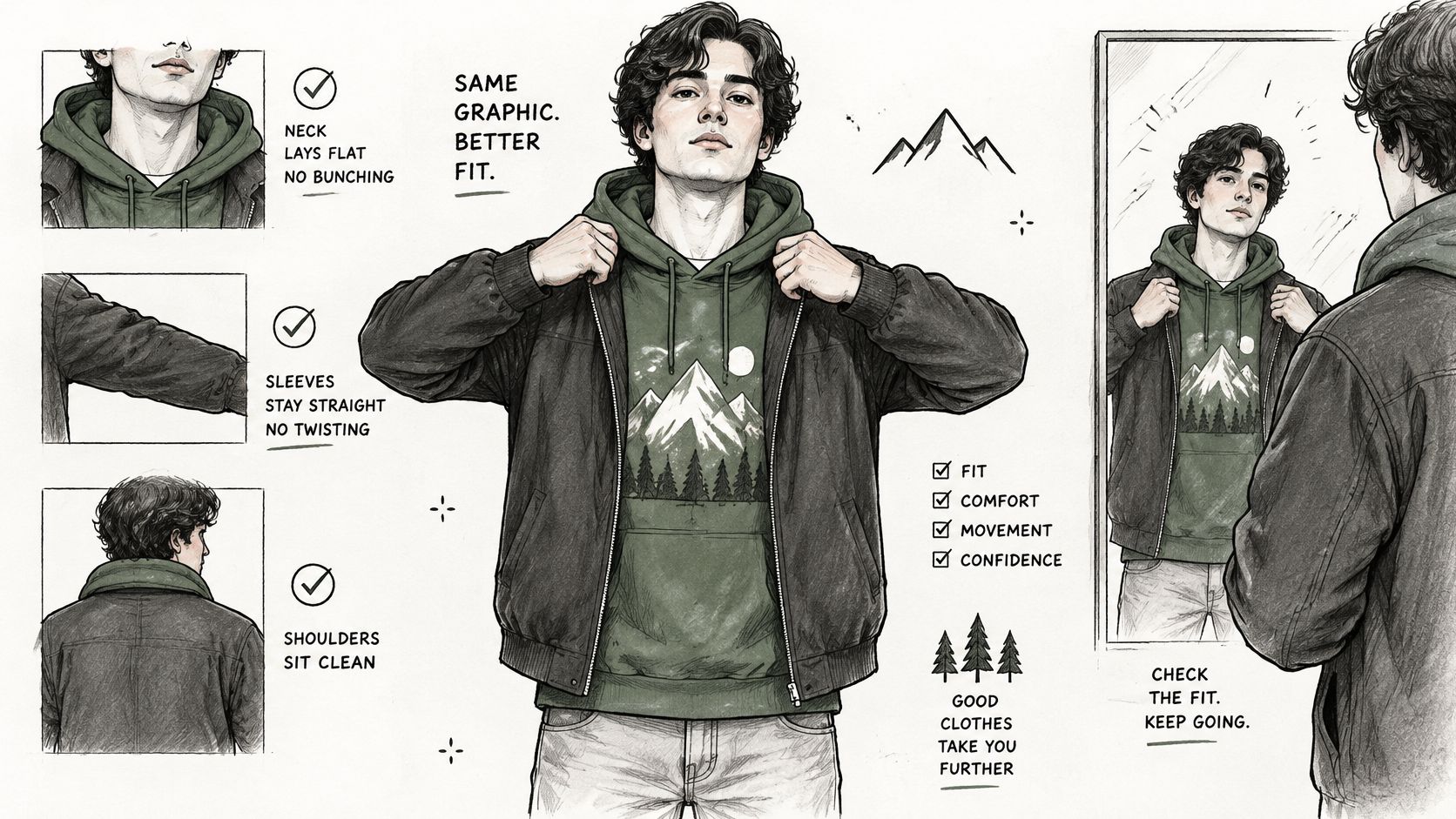
A good outer layer frames the print rather than covering it. That means keeping the front panel visible, leaving clear space around the artwork, and never pairing two prints or two bulky pieces. An open jacket with the zip down does more for a chest graphic than any closed technical shell ever will.
| Layer | Works When | Watch For |
|---|---|---|
| Lightweight overshirt | Weather is mild and the hoodie should stay the main print | Shoulder seams that bunch when the arms rise |
| Denim jacket | The graphic is bold and needs a structured frame | Extra bulk at the elbows and under the arms |
| Shell or windbreaker | Wind, light rain or an outdoor day | Crinkly fabric that competes with the print |
| Puffer or heavy coat | Cold days when the graphic is small or on the back | Sleeves twisting and a neck that bunches under the hood |
Layering rule: if the graphic disappears the moment the jacket closes, the jacket is the outfit and the hoodie is underwear.
A hoodie under a heavy coat is a practical choice only when the graphic is secondary, such as a small chest logo or artwork printed on the back. Anything large on the front gets swallowed, and you end up carrying the bulk without the visual payoff. If the print is a big Y2K graphic that needs a structured frame, these notes on styling Y2K graphic clothing go deeper on proportion and contrast.
Styling for Comfort, Heat and Movement
Oversized is not automatically comfortable, and treating it that way leaves people adjusting all day. A 2025 Iowa State University study of weighted hoodies, published by the International Textile and Apparel Association, found that participants valued softness and a calming effect but also reported bulkiness, stiffness, poor breathability, upper-back and neck strain, restricted mobility and arm-fit problems. Weighted garments aren't everyday streetwear, yet the complaints land exactly where heavy hoodies do: the fabric that holds a shape also traps heat and pulls on the shoulders.
Adjust by context, not by body type
- Travel: a relaxed hoodie with a light tee underneath, hood down while seated, and a jacket you can take off rather than a second heavy layer. Bulk in an airport seat becomes a problem within the hour.
- Study or desk days: breathable fabric, sleeves that stop at the wrist bone, and bottoms that don't fight the hoodie's volume. If you wear headphones most of the day, check the hood clears them before you commit to the piece.
- Commuting: open jacket, hem that clears the rise, and nothing scratchy at the neck. A hood that hangs heavy will drag the whole neckline forward once you add a bag strap.
- Outdoor use: a shell for weather, not a second fleece. Layer warmth at the base and keep the mid layer thin so the print stays visible.
A rule I'd apply first: if you can't raise your arms and sit down without rearranging the garment, the silhouette is doing the work of the outfit and failing at it.
The biggest styling upgrade isn't always more size. Reduced bulk, breathable layering and unrestricted sleeves beat trend conformity on any day that involves movement.
Plan Your Next Hoodie Outfit This Week
A heavyweight hoodie drapes well and makes a large print look intentional. It also runs hot in a warm room, layers badly under a jacket and costs more to wash and dry. One well-chosen hoodie can still anchor a full week of outfits, which is why rotation matters more than novelty. The more days a single garment carries a look, the more each wear earns back.
Three habits follow from that:
- Wash less often. Spot-clean collars and cuffs, air the hoodie between wears, and wash it when it needs it rather than on a fixed schedule.
- Air-dry where you can. It protects the print and the ribbing, and it's the cheapest way to keep the graphic crisp.
- Rotate through the formula. The same hoodie with different bottoms, footwear and layers reads as a different outfit, which is the entire argument for buying fewer.
The plan itself takes one evening. Pick the hoodie you'll wear most this week and confirm the print still reads clearly from across a room. Run the five measurements on the garment itself so you know exactly what you're working with before you commit it to the rotation. Then build three outfits from the occasion table for three different days, for example errands, a smarter evening and a commute.
If any of those days needs a second print to work, that gap is the one worth filling. Flux Riot's range runs across motivational wording, sports, outdoor lettering, Y2K graphics and seasonal art, with featured pullover hoodies starting at $54.99, so a new piece can cover an occasion your current one doesn't. Take the five measurements, choose the occasion formula that matches your week, and let one print carry the outfit. Visit Flux Riot to find a hoodie that earns a place in your rotation rather than a spot in the back of the drawer.