How to Style Y2K Graphic Clothing: 5 Outfit Formulas
Learn how to style Y2K graphic clothing with silhouettes, color pairing, layering, accessories and six adaptable outfit formulas you can wear anywhere.
In this article
- The One Statement Graphic Rule for Y2K Outfits
- Where Y2K Styling Tips Into Costume
- Outfit Formulas Built Around a Graphic Tee
- The Rule That Builds All Six
- Silhouettes That Keep a Loud Print in Proportion
- Color Pairings That Keep the Print in Focus
- How to Use the Table
- Layering and Accessories That Finish the Look
- Build Your First Y2K Graphic Outfit This Week
Most Y2K styling advice tells you to rebuild the entire early-2000s wardrobe in one outfit. Low-rise jeans, a baby tee, a studded belt, tinted sunglasses, a mini shoulder bag, and something metallic, all at once. That version looks great on a mood board and falls apart on a real person on a real Tuesday, because nothing in it is in charge.
The skill isn't collecting the most retro pieces. It's making one loud graphic carry the reference while the rest of the outfit does quieter work. That's the difference between a look that earns a compliment and one that earns a joke about 2002. It's also the only version of how to style Y2K graphic clothing that survives beyond a single photo.
The One Statement Graphic Rule for Y2K Outfits
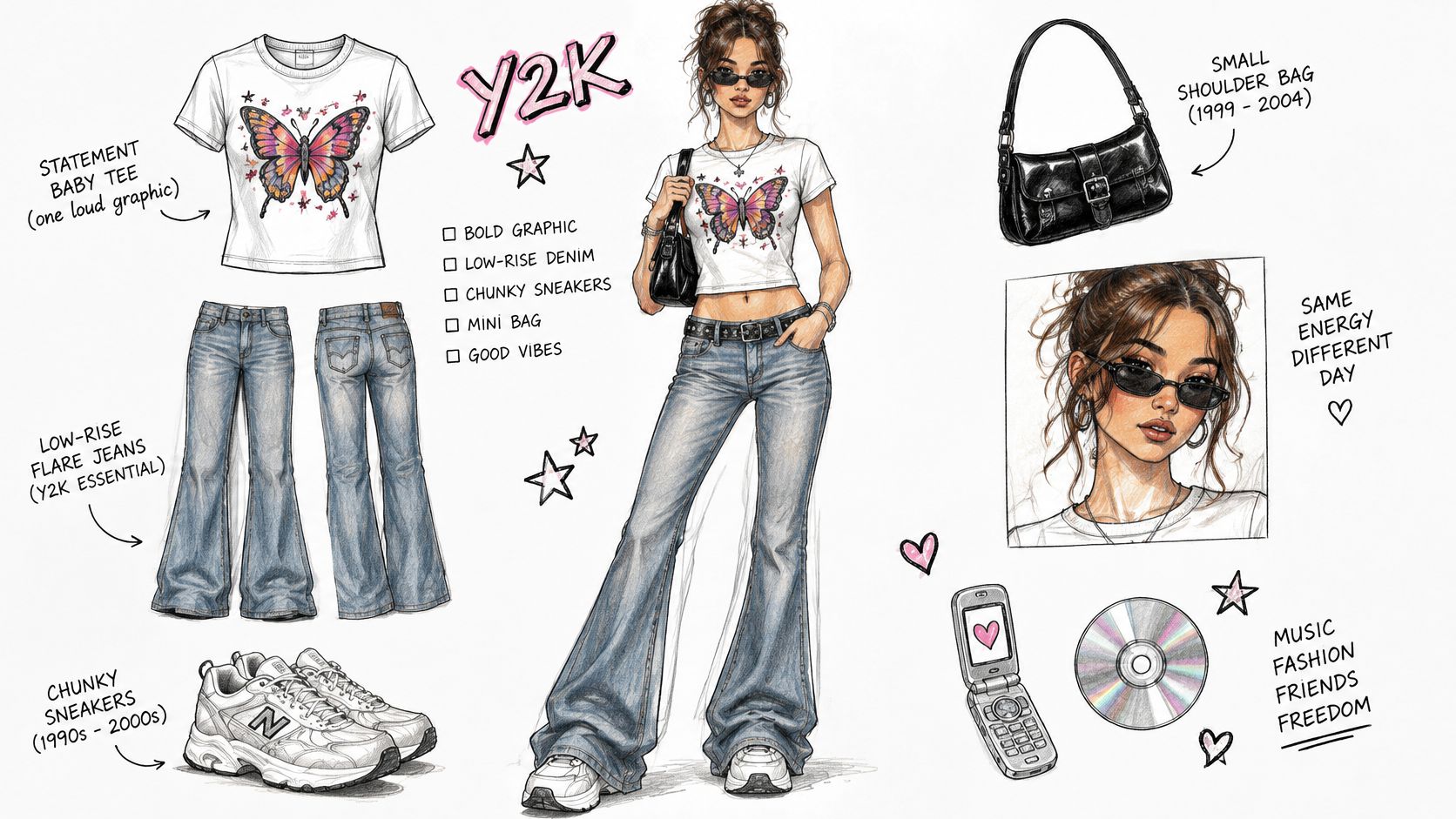
A Y2K graphic outfit works when one loud graphic carries the reference and two or three period cues support it. That's the whole rule. Y2K is a late-1990s-to-mid-2000s style system rather than a fixed uniform: bold color, shiny or metallic surfaces, playful typography, baby tees, denim, low-rise or flared bottoms, and conspicuous accessories all belong to it. The graphic is the part people read, so let it speak first.
The sketch below shows what that looks like when the tee leads and everything else follows.
You don't need the full wardrobe to participate. An Ipsos analysis of social data reported that online mentions of Y2K fashion increased 82% over a 12-month period and that the hashtag #Y2K exceeded 6.2 billion TikTok views, with the surrounding styling talk clustering around chunky sneakers, flare jeans, cropped shirts, and velour tracksuits. Millions of people are sharing a small vocabulary of pieces, which means the entry cost is one garment, not twelve.
A worked example: graphic sweatshirt, cargo pants, chunky sneakers. The sweatshirt says early 2000s, the cargo silhouette says streetwear, and the shoes hold the proportions together. Swap the cargo for straight-leg denim and a solid overshirt and the same sweatshirt reads as modern weekend wear. Swap the sneakers for boots and add metallic jewelry and it reads as nightlife. One garment, three lives.
Where Y2K Styling Tips Into Costume
The failure mode is stacking. A slogan tee plus low-rise flares plus a rhinestone belt plus metallic jewelry plus tinted sunglasses reads as fancy dress, because every item competes for the same attention and none of them wins. Logomania accelerates it: a logo-heavy print paired with a logo-heavy bag and logo-heavy shoes stops looking styled and starts looking branded.
The fix is a one strong reference rule. Pair a brutalist or nostalgic graphic sweatshirt with modern straight-leg denim, minimalist sneakers, or neutral outerwear, then escalate through color, layering or accessories only if the look needs more. Nostalgia in one place reads as intent. Nostalgia everywhere reads as a costume.
Rewearing is the other half of the rule, and it's how people are shopping anyway. One 2025 report cited in Fashion Times' coverage of the Y2K revival found that 42% of Gen Z shoppers buy second-hand in pursuit of throwback looks. If you're buying second-hand or buying once, a single expressive garment worn three ways beats a trend-specific outfit worn once.
The cover test: hide the graphic with your hand. If the outfit still reads early 2000s, remove one period cue. If it now reads as generic basics, add one.
Run that test before you leave the mirror, not after you've seen the photos.
Outfit Formulas Built Around a Graphic Tee
Six formulas cover most of what you'll wear. Each starts from a graphic piece and lets the bottom supply the Y2K proportions.
| Graphic piece | Bottom | Footwear | Accessory | Best for |
|---|---|---|---|---|
| Baby tee with slogan | Low-rise flare jeans | Chunky sneakers | Rhinestone belt or mini shoulder bag | Night out or weekend brunch |
| Cropped graphic tee | Denim mini skirt | White platform sneakers | Tinted sunglasses | Warm days and casual plans |
| Oversized graphic tee | Cargo pants | Chunky sneakers | Small shoulder bag | Everyday streetwear |
| Graphic sweatshirt | Pleated mini skirt | Knee-high socks with sneakers or boots | Metallic jewelry | Cooler weather |
| Graphic tank top | Wide-leg denim | Flat sneakers or sandals | Layered chains and sunglasses | Summer and travel |
| Graphic hoodie | Straight-leg denim | Chunky sneakers | Dad hat or mini bag | Lounge-to-street days |
The Rule That Builds All Six
Every row obeys one principle: contrast. Combine a loud print with a comparatively simple bottom, or balance a simple graphic top with oversized denim or a track jacket. Printful's history of the graphic tee makes the same point about the era itself, noting that printed slogan shirts became mainstream through the visibility of celebrities such as Paris Hilton and Britney Spears, which is exactly why a text-based top now carries instant period recognition on its own.
Read the rows by mood, not by decade. A baby tee with low-rise flares and a rhinestone belt is 2000s pop. A cropped tee with a denim mini and white platforms is early-2000s casual, the kind of thing worn to a mall. An oversized tee with cargo pants and chunky sneakers is current streetwear with a period nod, which is the safest of the six for anyone testing the look for the first time.
The most useful move is the swap rule: keep the graphic and the footwear constant and change only the bottom. Same tee, same chunky sneakers, denim mini for daytime and a leather-look skirt or wide-leg trouser for evening. One decision instead of a new wardrobe.
If you're matching a formula to something you can buy, Flux Riot stocks graphic tees, tank tops, crewneck sweatshirts and pullover hoodies across those categories, so the table maps onto a silhouette rather than a single product.
Practical rule: choose one row, then replace one item with something you already own. A formula you can't assemble from your closet is a shopping list, not a styling method.
Silhouettes That Keep a Loud Print in Proportion
The most common fit mistake is buying a larger size and calling it oversized. It isn't the same thing. Intentional oversized styling has shoulder seams that drop past the shoulder point and a hem that lands at the hip, with a body wide enough to hold its shape. A bigger size on an unchanged bottom just looks like the wrong size, because the proportions below it never adjusted.
Proportion is what makes a graphic look styled rather than accidental. Four pairings do most of the work:
Fitted or cropped top with low-rise flares or a denim mini: the close top and wide bottom create the period silhouette without extra pieces.
Oversized tee with a straight-leg or fitted bottom: volume on top needs a clean line underneath or the whole outfit reads as a bag.
Cropped layer over a longer tank: two lengths give coverage and movement, and the longer hem keeps the midriff from being the only story.
Tucked tee with a high-rise skirt: the highest-coverage option, and the one that works for readers who want the reference without the exposure.
Graphic scale matters as much as garment scale. A large back print needs the room an oversized fit gives it, and it will look cramped and cropped on a fitted tee. A small chest print suits a fitted or baby tee, where the graphic sits in a tight frame. Sleeve length changes things too: capped sleeves sharpen a fitted top, dropped sleeves soften an oversized one.
Fit is also where online apparel loses money. Podean's apparel eCommerce report puts returns of apparel bought through e-commerce at approximately 24.4% in 2023, with size or fit accounting for 38% of returns. Buying a graphic you can't try on is a fit decision before it's a style decision, so check the measurement chart against a tee you already like rather than against your usual letter size.
Stand sideways in the mirror and check where the hem falls against your waist, then confirm the print isn't cut off by a seam or swallowed by a layer. In warm weather, move to a cropped or sleeveless graphic tank with wide-leg denim and keep the same proportion rule. In cold weather, wear a fitted long-sleeve layer under an oversized graphic sweatshirt so the print still sits at the right scale under your outerwear instead of bunching at the ribs.
Color Pairings That Keep the Print in Focus
Let the graphic set the palette, add one accent, and keep the bottom neutral or tonal. Y2K color is bright and shiny by nature, so the outfit can carry one shiny element at most. A chrome bag or metallic jewelry, not both plus sequins. Two competing brights fight each other, and a logo-heavy print next to another logo reads as clutter rather than coordination.
| Graphic color | Pair with | Accent to add | Avoid |
|---|---|---|---|
| Black | Silver or chrome details, faded blue denim | Metallic jewelry and white sneakers | Black on black with shiny fabric everywhere |
| White | Light wash denim or pastel bottoms | Icy blue or lilac bag | Pure white on white head to toe |
| Bright pink or magenta | Navy or mid-wash denim | Silver hoops or chain | A second neon color competing for attention |
| Lime or electric green | Charcoal or black cargo pants | Black sneakers | Neon green paired with orange |
| Heather grey | Ink-dark denim | Tinted sunglasses or chrome bag | Grey on grey with no accent at all |
| Cobalt or royal blue | White or pale denim | Silver chain | Navy bottoms that blend into the blue |
How to Use the Table
Find the dominant color of the graphic first, not the secondary one. A tee with pink lettering on a black body is a black graphic, so it reads down the black row: silver, faded denim, white sneakers. Pick one accent from the same row and check that the avoid column doesn't describe what you just chose.
Multi-color prints need one extra decision. Pick the calmest color in the artwork and match the bottom to it. A busy print with pink, lime and white gets a charcoal or black bottom, and the print does the shouting while the outfit stays quiet.
A concrete example of the whole system: a pink slogan baby tee with navy flares and silver hoops. The pink does the work, the navy stays quiet, the silver is the single shiny detail. Nothing else needed.
Layering and Accessories That Finish the Look
The order matters more than the individual pieces. Build upward and outward, and stop when the graphic is still the first thing anyone notices.
The two steps that carry the most weight are the base and the layer that frames it.
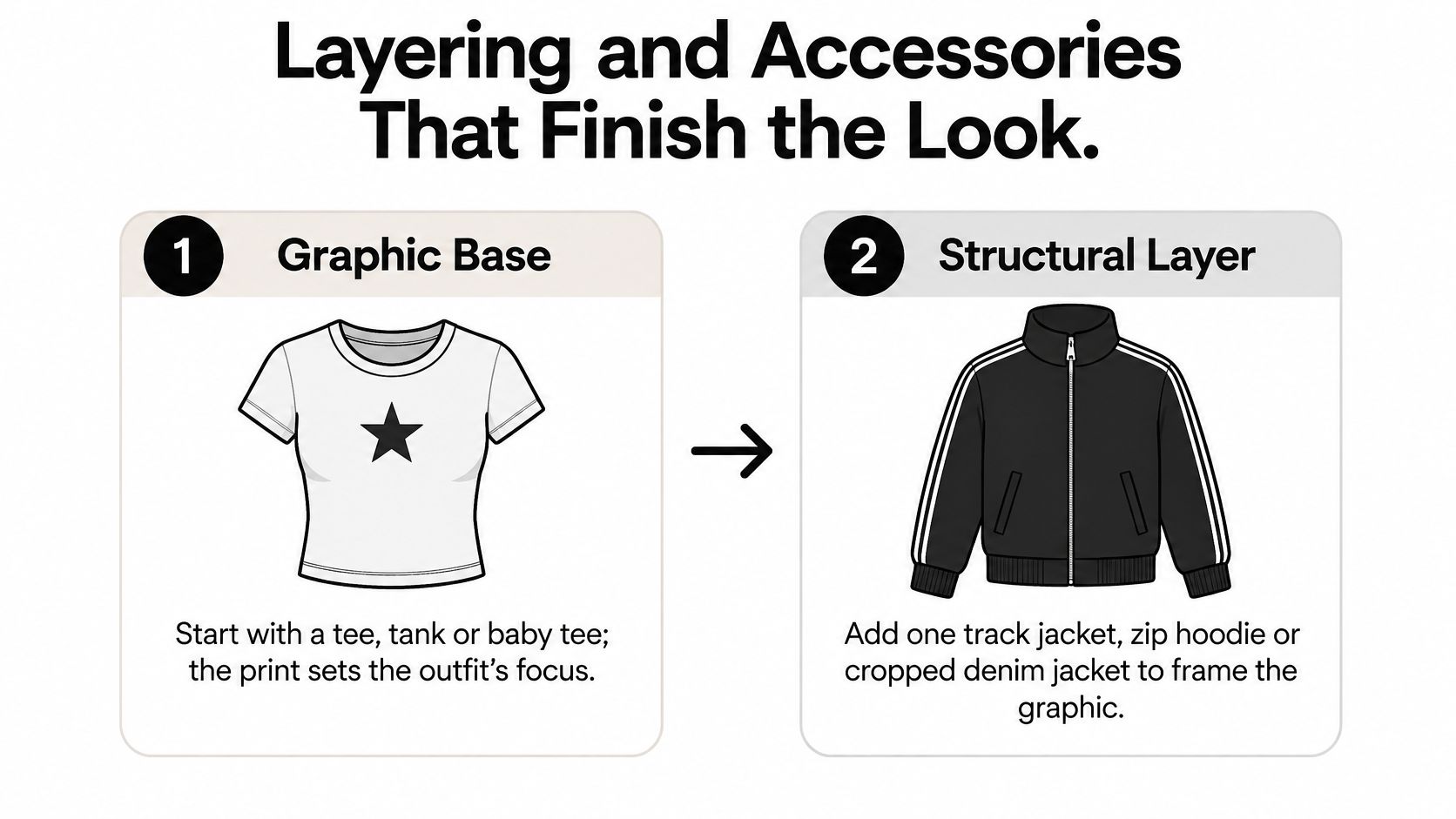
Start with the graphic base. A tee, tank or baby tee, chosen before anything else, because the print sets the focus of the whole outfit. Pick this first and the rest of the decisions get easier; pick it last and you'll be shopping for a layer to justify a jacket you already wanted to wear.
Add one structural layer. A track jacket, zip hoodie or cropped denim jacket gives the outfit the Y2K proportions it needs across the shoulders and the waist. If the base is loud, the layer should be solid. The common slip is a graphic jacket over a graphic tee, which puts two prints in direct competition.
Set the bottom from your chosen formula. Keep its silhouette in line with the top's fit: close top, wide bottom; oversized top, straight or fitted bottom. Changing both the top and bottom volume at once is how outfits lose their shape.
Choose footwear. Chunky sneakers, platform sneakers or low boots. Footwear is what stops a graphic tee and jeans from reading as errands, so don't treat it as an afterthought.
Add one bag. A small shoulder bag or mini bag is the period detail almost everyone leaves out, and it does more for the Y2K read than any single garment after the graphic.
Finish with one or two accessories. Tinted sunglasses, rhinestone details, metallic jewelry, or a dad hat for sporty and outdoor graphics. Stop at three visible accessory types total, counting the bag.
If you want to see the layering order in motion before you commit, this walkthrough runs through the same sequence.
For readers who want a fuller retro set rather than a single statement, a velour tracksuit is the one full-look option that works as a unit. Keep everything else minimal when you wear one, because the set is already doing the maximum.
Build Your First Y2K Graphic Outfit This Week
Three moves, in this order.
Pick one graphic you already own. A slogan tee, a band-style print, a graphic sweatshirt sitting unworn. If you're buying, choose a silhouette you'll repeat: a graphic tee, tank top, crewneck sweatshirt or pullover hoodie. Check the product page before you commit, since listed prices vary by product and several garments display starting prices rather than a single fixed amount.
Choose one row from the formula table and match the bottom to the graphic's silhouette. Fitted graphic, wide or flared bottom. Oversized graphic, straight or fitted bottom. If nothing in your closet fits the row, pick a different row instead of buying a bottom you'll wear once.
Add the bag and accessories last, following the layering order and stopping at one bag and no more than two accessories. That cap is what keeps the outfit from sliding toward costume.
Then run the graphic through your week. Sneakers and denim for everyday. Solid trousers and loafers for work-casual, where the print reads as personality rather than theme. Bolder bottoms and metallic jewelry for nightlife. Same garment, three registers. A graphic that only works at a theme party never earns its drawer space, and rewearing it across registers is what separates styling from dressing up.
Check the mirror once before you go: the graphic should be the first thing someone notices, and nothing else should be competing with it.
One loud graphic, two period cues, one shiny detail.
Flux Riot carries graphic tees, tank tops, crewneck sweatshirts, pullover hoodies and dad hats suited to this kind of modular styling, so one expressive piece can move across your week instead of sitting in a drawer between theme parties. Browse Flux Riot's graphic apparel collections and start with a single statement piece, then build the two or three supporting cues around what you already own.