How to Choose Graphic Sweatshirts for Everyday Wear
Learn how to choose graphic sweatshirts for everyday wear by checking fabric weight, fiber blend, care labels and print durability before buying.

In this article
The sweatshirt that gets worn three times a week is rarely the one that looked best in the product photo. It's the one whose fabric weight matched the weather, whose cuffs still snap back after a winter of washing, and whose print hasn't gone chalky across the chest.
Most buying advice for graphic sweatshirts stops at the design. You're told to pick a colorway that suits your wardrobe, then eight weeks later the brushed inside has pilled and the graphic is cracking along the shoulder seam. Choosing graphic sweatshirts for everyday wear means judging the garment as equipment, not just as artwork.
Here's how to do that in the order that saves you money: your wear pattern first, then fabric weight, then a physical inspection, then the safety and durability evidence, then the care routine that decides how long any of it lasts.
Start With How You Will Actually Wear It
The decision starts with your week, not the product page. Before you compare graphics, write down the three outfits you repeat most. A 10°C morning that climbs to 20°C by afternoon calls for a midweight crewneck you can carry, not a heavy fleece you'll be holding by noon.
A shopper choosing between two prints is really choosing how many outfits each one can carry.

Layering narrows the fit. Worn over a tee or under a jacket, a regular fit keeps the sleeve from bunching at the elbow and the hem from riding up. Worn as the outer layer on its own, an oversized cut works with wide trousers and sneakers, and the extra volume is the point rather than an accident.
Style decides the volume of the print. Someone in black jeans and white sneakers most days can wear loud Y2K lettering once a week. The other four days need a quieter mark, a small chest graphic or a monochrome design, or the sweatshirt becomes the whole outfit every time it leaves the house. If bold lettering is the direction you want, the guide to styling Y2K graphic clothing shows how to keep everything else quiet so the print carries the look.
The brief: one line covering the weather you face, the outfits you repeat, and how loud the print should be. If two sweatshirts both pass that brief, the fabric numbers decide.
Fabric Weight Ranges and What Each One Means
Fabric weight is the fastest filter you have, and most listings print it as GSM. For a crewneck worn most of the year, aim at 280 to 340 GSM. That range layers under a jacket without bunching, holds a large print flat, and still breathes on a warm train.
The Dhālay International sweatshirt fabric guide sets out the same sequence: weight first, fiber second, construction third, post-wash stability last. It puts 220 to 280 GSM in the layering and mild-climate bracket, and 340 to 380 GSM in the structure-and-warmth bracket that trades away breathability.
| Weight class | GSM range | Best for | Trade-off |
|---|---|---|---|
| Lightweight | 220-280 | Layering, mild climates, warm offices | Less warmth; thin fabric can show a large print |
| Midweight | 280-340 | Year-round crewneck, commuting, routine washing | Balanced; the safe default |
| Heavyweight | 340-380 | Cold climates, oversized streetwear | Less breathable; slower to dry |
Fiber is the second decision. Cotton feels softer and breathes better. Polyester dries faster, holds its shape and resists shrink, though it can feel warmer against skin. A cotton-polyester blend is the practical answer for a graphic worn weekly, because it keeps the print surface stable and survives a dryer better than pure cotton. The same guide notes that cotton-rich garments carry real shrinkage risk, with roughly 5 to 8% shrinkage reported for some 100% cotton sweatshirts, so size accordingly rather than hoping.
The trap: GSM is not a quality score. Two fabrics at identical weight can pill at completely different rates because yarn quality and fiber length differ, which is why weight shortlists a garment and never closes the sale.
Say you work in a 12°C office and layer over a tee five days a week. A lightweight cotton blend at around 250 GSM is the better call, because you'll never overheat indoors. The same person commuting outdoors on a 2°C morning needs midweight with more body, and possibly a hoodie underneath.
How to Check a Sweatshirt in Five Steps
Five checks, done in under two minutes on a garment you're holding or a listing that publishes its specs.
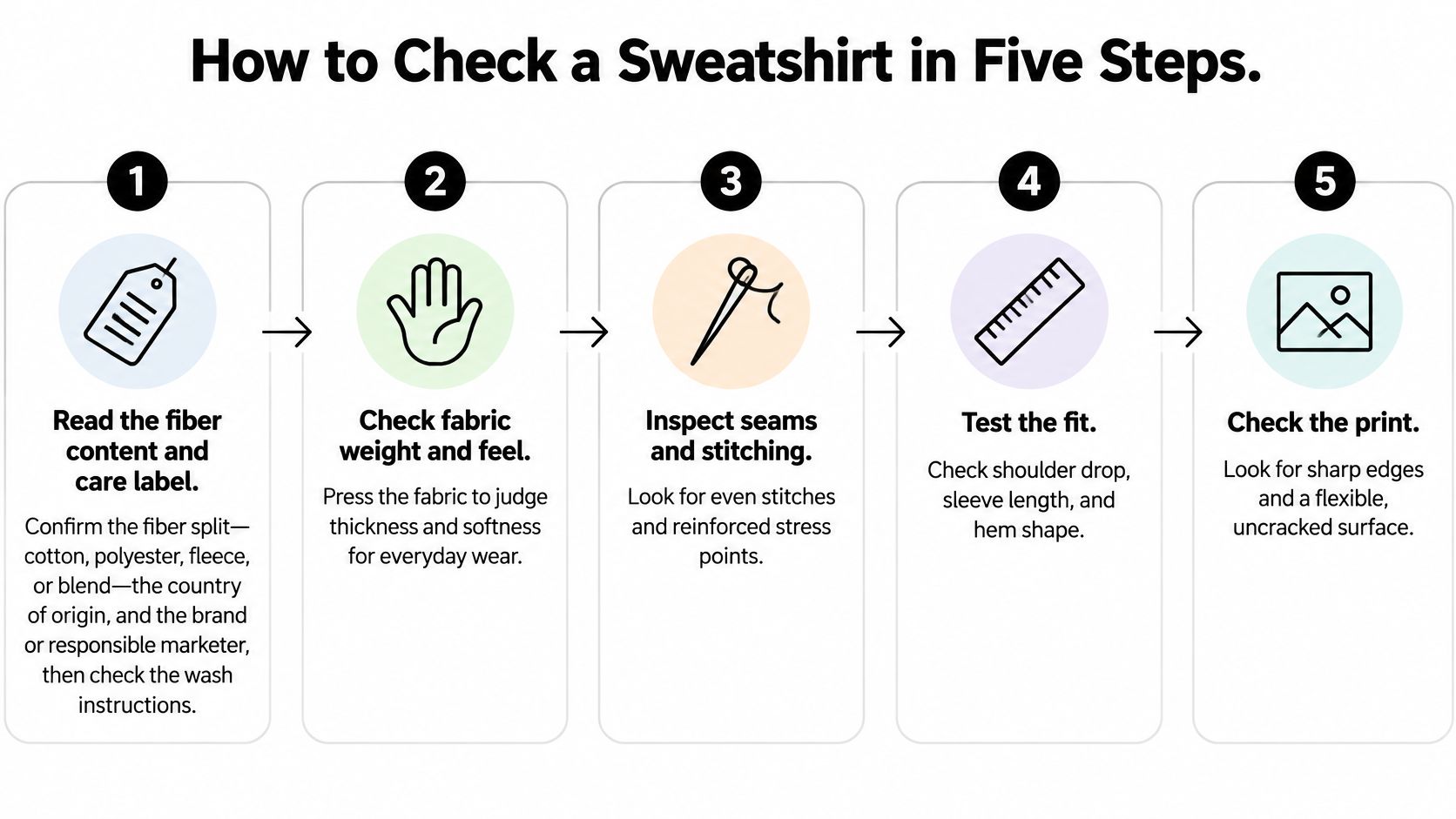
Read the fiber and care label. In the United States, Federal Trade Commission textile-labeling rules require most textile products to identify fiber content, country of origin and the manufacturer or responsible marketer, with a separate care-labeling rule covering cleaning instructions. That turns a good-looking graphic into a measurable purchase: you can see the cotton-polyester split, where it was made, and whether it's built for routine washing or needs special handling.
Confirm the weight. Look for GSM or ounces per square yard on the listing. No stated weight on a premium-priced sweatshirt is a warning sign, not a technicality.
Stretch the cuffs and waistband. Ribbing with enough elastane snaps back immediately. Ribbing that stays stretched has already given up, and the garment will look baggy within a few wears regardless of how good the body fabric is.
Inspect seams and print. Run a thumb along the shoulder and armhole seams for even stitching and reinforcement at stress points. Then look at the print edge: sharp boundaries and a flexible surface suggest a cured screen print or decent transfer, while a stiff, plastic-feeling patch will crack first.
Check your wash plan against it. If you wash weekly in a machine and air dry, most decent midweight garments cope. If the care label demands dry cleaning or hand washing, it isn't an everyday sweatshirt, whatever the graphic says.
A short walk through what separates a garment that survives washing from one that doesn't:
Decision rule: a sweatshirt that fails two of these five checks is not your everyday piece, however good the print looks.
Certifications and Skin-Contact Safety
Skin contact happens at the cuffs, collar and inside face of the body fabric. Those points rub every time you wear the sweatshirt, so an appealing graphic tells you little about day-long comfort.
OEKO-TEX STANDARD 100 tests textile articles for harmful substances and covers every component, including sewing thread, buttons and zippers. Its criteria cover more than 1,000 harmful substances, with tighter limits where skin contact is direct or the intended wearer is more sensitive.
The system splits products into four classes: Class I for babies and small children, Class II for materials with direct skin contact, Class III for materials without direct skin contact, and Class IV for home textiles. For a sweatshirt worn over a tee, with cuffs and collar touching your wrists and neck, Class II is the relevant claim.
A named class gives you something specific to check. A generic leaf badge does not. Many product pages leave buyers unsure how a garment was made, and independent testing helps reduce that uncertainty. Certification still says nothing about warmth, fit, print durability or environmental impact. Use it alongside fabric weight, construction and your actual wash routine. If two comparable sweatshirts meet those needs and one names Class II, that is the safer pick.
Print and Fabric Problems After Washing
Pilling shows up first. Fine fibers work loose through friction, and the brushed face that felt plush in the shop looks tired within a few months. Pilling is rated on a 1 to 5 visual scale under standards such as ASTM D3512 and ISO 12945, and a stated grade around 3 to 4 is a sensible minimum for a sweatshirt washed weekly, with the acceptable level shifting with price and intended look.
Print durability hinges on colorfastness. Where a listing publishes wash testing, the textile testing standards guide points to ISO 105-C06 results and a grade around 4 as the benchmark worth having. Abrasion tests, ISO 12947 or ASTM D4966, matter for graphics and cuffs that rub against bags and desk edges all day. Dimensional change is the quiet failure: one industry specification cited in that guide allows cotton hoodies roughly -5% in length and -4% in width after washing, which is exactly why you size up rather than hope.
| Symptom | Likely cause | Fix |
|---|---|---|
| Pilling on the brushed face | Loose fibers and friction from low-grade yarn | Wash inside out on cold; choose fabrics rated around 3-4 for pilling or better |
| Print cracking or fading | Weak colorfastness, hot washing or hot drying | Wash inside out on cold, air dry, keep heat away from the print |
| Body or sleeves shrink | Cotton shrinkage, within the -5% length and -4% width allowance | Size up on cotton-rich styles; wash cool |
| Cuffs lose stretch | Weak elastane ribbing | Test cuff recovery before buying; accept a shorter lifespan if it fails |
| Hem twists or spirals | Fabric spirality from an uneven knit | Choose tighter knits; avoid heavy tumble drying |
Three pitfalls cost people the most money. Treating high fabric weight as a guarantee of longevity, ignoring spirality and post-wash dimensional change, and trusting a vivid graphic applied with a cheap heat transfer that survives the first wash and cracks by the twelfth.
Care Habits That Make a Sweatshirt Last
Your wash routine decides more about a sweatshirt's lifespan than the brand does. A pan-European study of 14,000 adults found that gentler washing could extend garment life by more than 50%, yet only 12% of respondents recognised that wash-cycle duration affects clothing life, according to the Electrolux Truth About Laundry report. The same study found cooler, shorter cycles generally preserve garments and reduce both color loss and microfiber release.
So run the quiz before you buy, not after the first shrink.
- How often will you wash it? Weekly means you need firm ribbing and a print that tolerates repetition. Monthly means you can buy softer, lighter fabric.
- Do you have a cold or 30°C cycle? If yes, cotton-rich fabrics become far more viable.
- Do you tumble dry? Regular hot drying is the single fastest way to shrink a cotton crewneck and crack a print.
- Does your climate demand warmth? If you're outdoors in real cold, heavier fleece earns its slower drying time.
- Must it look presentable at work? Then structure and colorfastness outrank softness.
If you wash weekly, dry by machine and need it sharp, buy a cotton-polyester blend with firm ribbing and a print that tolerates heat. If you wash cold and air dry, an oversized cotton piece is a better use of your money. Wash inside out, use a mesh bag for the printed panels, and skip fabric softener on stretch ribbing.
Practical rule: wash cool inside out, air dry flat, and a midweight sweatshirt will look presentable for years rather than months.
Pick Your Finalist and Buy With Confidence
Shortlist two or three sweatshirts that pass the five checks, then score each against the brief you wrote at the start: weight for your climate, fiber and care for your wash routine, print volume for your dressing style.
Take a shopper with a 12°C office, a weekly machine wash and a taste for loud graphics. Midweight cotton-polyester at around 300 GSM wins over heavyweight fleece even if the fleece photographs better, because fleece worn indoors runs too warm and dries slowly between weekly washes. The lighter garment loses on paper and wins in the wardrobe.
The tiebreaker: when two garments score the same, buy the one with clearer published information on fiber content, shrinkage and care.
Before you order, confirm stock and price on the product page, read the shipping and refund policy, and check that the listing states fiber split and care instructions. A listing that hides construction detail is telling you something useful. Flux Riot's crewneck sweatshirt and pullover hoodie range is one place to apply this checklist; as with any storefront, confirm the fiber, weight and care details on each product page before you spend.
Then buy the finalist, wash it the way you plan to wash it for the next two years, and note how it looks after ten cycles. That note makes your next purchase a five-minute decision instead of another experiment.
The next time you're weighing a bold Y2K print against a hiking mark, judge it the way you'd judge a jacket: weight, fiber, seams, care. Flux Riot's graphics, from motivational wording to outdoor lettering, are aimed at repeat wear, which makes that checklist worth running on every candidate. Browse the Flux Riot graphic sweatshirt collection and shortlist the ones that match your brief, not just your mood.